Research-led explainer · robotics and physical AI
Robot motion intelligence: from intent to physical action.
Robot motion intelligence is the set of capabilities that allows a machine to interpret a goal, plan feasible movement, generate control signals, operate its actuators and adapt through physical feedback.
Conceptual research resource · Not an operating product or research institution

Definition
Physical action is repeatedly corrected, not simply played.
A robot starts with an observation and a goal: identify an object, move through a space, place a component or maintain a body velocity. It must interpret the goal in relation to its environment and body, find a feasible course of action, produce time-dependent commands and observe what actually happens. Disturbance, friction, latency, uncertainty and contact make a fixed animation insufficient.
Robot motion intelligence is a system-level description for those connected capabilities. It does not imply one universal architecture. A factory manipulator may use explicit models and deterministic planners. A mobile or legged system may combine learned perception, task planning, trajectory optimisation and feedback control. A generalist policy may predict actions directly while still relying on safety filters and hardware controllers.
- 01PerceptionRobot and environment state
- 02Spatial and physical reasoningRelationships and consequences
- 03Task planningWhat should happen next
- 04Motion planningFeasible route
- 05TrajectoryMovement through time
- 06PolicyState or observation to action
- 07ControlContinuously corrected command
- 08ActuationForce and movement
- 09FeedbackObserved physical result
Feedback returns to the loop ↺
The boundaries can overlap. The value of the model is to expose the responsibilities between semantic intent and physical execution.
Planning
A path becomes useful when it is feasible, timed and controllable.
Motion planning searches for a route between states while respecting obstacles and constraints. A manipulator may plan in joint space or ask its end effector to reach a pose. Collision checking considers the robot, attached objects and environment. Constraints can restrict joint values, position, orientation or task-specific relationships.
A geometric path specifies where to go. A trajectory adds time, including velocities and accelerations. That distinction matters because hardware cannot change state instantaneously. Time parameterisation must respect joint limits and give the controller a reference that can be tracked. Optimisation can then trade path length, smoothness, clearance, energy or task objectives.
Dynamic environments motivate hybrid planning. A slower global planner can find a route through the wider scene while a faster local planner adapts to immediate changes. Replanning is not failure; it is a consequence of acting in a world that may not match the initial model.
Collision avoidance is necessary but not sufficient
A collision-free trajectory can still demand impossible acceleration, violate contact or produce unstable forces. Geometric planning, trajectory generation, dynamics and control therefore form a chain. The right level of modelling depends on the robot, speed, payload, task and acceptable risk.
Genuine motion study
Planning narrows possibilities; feedback changes the action.
This original animated SVG shows perception producing several path alternatives, constraint rejection, selection of a trajectory, articulated execution and a feedback return. It is deliberately architectural rather than a software dashboard or targeting display.
- 01Perception
- 02Reasoning
- 03Task objective
- 04Motion planning
- 05Trajectory
- 06Policy
- 07Control
- 08Actuation
- 09Feedback
The selected path is not treated as immutable. Sensor feedback returns to the system so the next command can correct the physical result.
Policy and reasoning
Learned policies connect observations with action.
A robot policy maps a state or observation to an action. The action might be a high-level skill, an end-effector target, a short action chunk or a low-level joint command. That choice determines how much planning and control sits inside the model and how much is delegated to other components.
Imitation learning uses demonstrations to teach a policy what behaviour to reproduce. Reinforcement learning optimises behaviour through rewards received during interaction. Offline datasets can supply diverse trajectories without new exploration. Each approach has limitations: demonstrations may omit recovery, reward design can produce unintended strategies, and pooled data may hide embodiment differences.
Vision-language-action models
Vision-language-action, or VLA, models condition robot actions on visual observations and language instructions. RT-2 showed one approach in which robot actions were represented alongside language tokens. OpenVLA documents an open model trained across a large set of robot episodes. These systems seek to transfer semantic knowledge and broaden task generalisation.
VLA is a model category, not a complete safety architecture. A practical deployment must still manage continuous values, control frequency, latency, robot-specific calibration, failure detection and limits on what the system may do. Some architectures add specialised action heads rather than treating control exactly like text.
Embodied reasoning and world models
Embodied reasoning asks how semantic intent relates to space, physics, embodiment and action consequences. A world model predicts relevant future state under possible actions. Planning can use those predictions to compare outcomes before execution. “World foundation model” is a newer, evolving label for broadly pretrained predictive or generative models intended to support multiple physical-AI tasks; vendor taxonomies differ and should not be treated as one standard.
Training and transfer
Simulation makes experience scalable, not automatically real.
Robotics simulation models articulated bodies, environments, sensors, contact and dynamics in software. It allows a planner or policy to experience failures without consuming hardware time or placing people and equipment at the same risk. Simulation can produce labels and trajectories that would be difficult to collect at scale.
Synthetic data is useful when variation covers factors that matter to the target task. Appearance randomisation can help visual perception. Dynamics randomisation can expose a policy to ranges of mass, friction, delay or actuator behaviour. The goal is not photorealism for its own sake, but sufficient coverage of task-relevant variation.
Sim-to-real transfer remains difficult because the model is incomplete. Contacts, sensors, wear, compliance and latency can differ from the simulator. Domain randomisation, system identification, cross- simulator testing, residual correction and limited real-world adaptation are ways to manage the gap. None replaces staged testing and explicit safety boundaries.
| Component | Question answered | Typical output | Strength | Limitation |
|---|---|---|---|---|
| Motion planner | Which route is feasible? | Path or trajectory | Explicit constraints and collision reasoning | Depends on model quality and search time |
| Learned policy | What action should follow this observation? | Skill, target or control action | Can absorb patterns from data and interaction | Failures can be hard to characterise |
| Controller | How should execution be corrected now? | Joint, force, torque or actuator command | Fast feedback and disturbance rejection | Tracks local objectives rather than choosing the full task |
Control and actuation
The intelligence layer and execution layer must remain distinct.
Motion control converts a desired state or trajectory into continuously adjusted commands. Position and velocity control track kinematic references. Torque control regulates joint force. Impedance control shapes how motion and force respond to contact. Servo and motor controllers operate at rates and interfaces determined by the hardware.
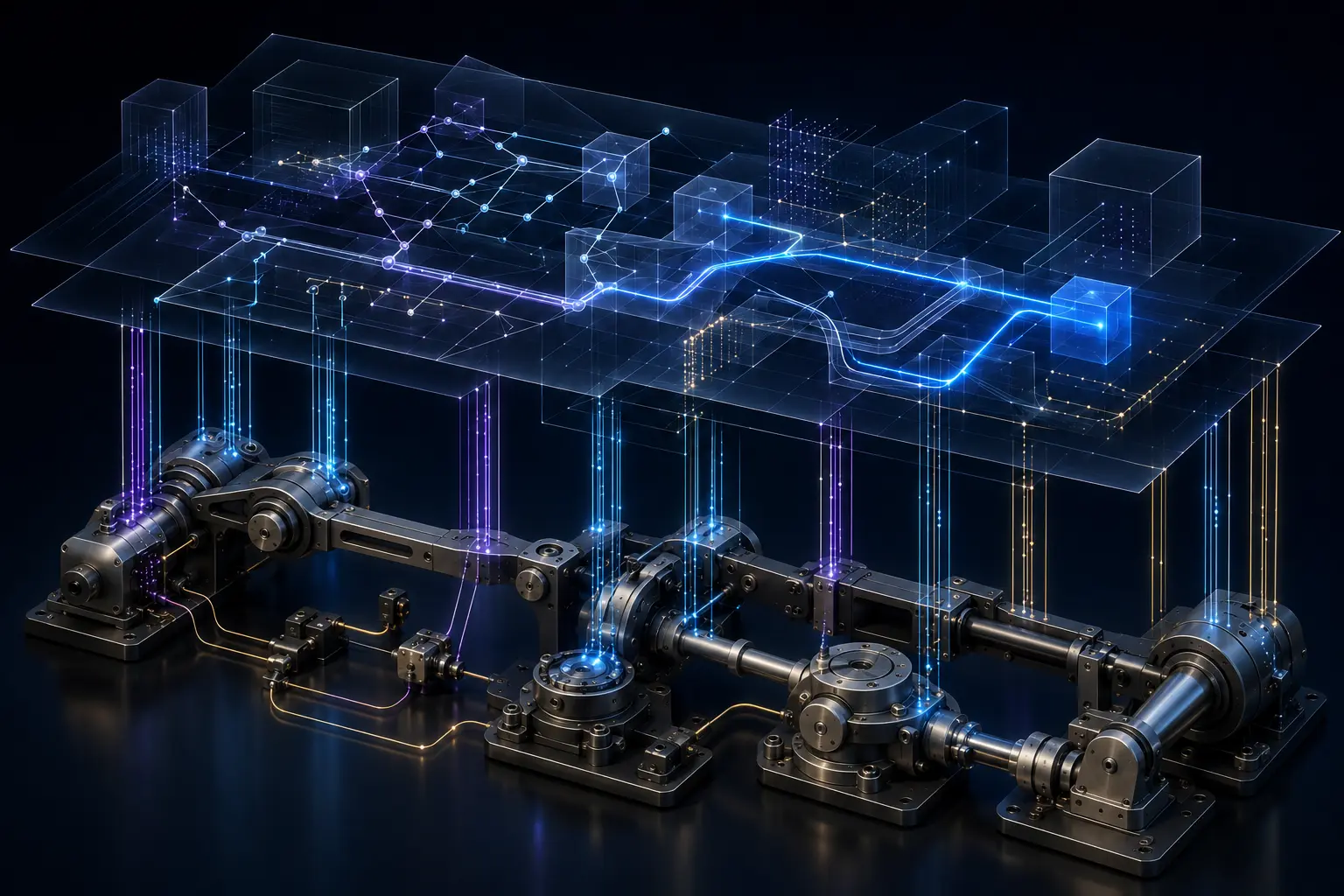
An actuator converts energy and a command into force or movement. It may include a motor, drive, transmission and integrated sensing. Its bandwidth, precision, compliance, torque, thermal behaviour and efficiency shape what the robot can do. Those capabilities are essential, but the actuator does not decide the task, interpret a scene or plan a collision-free motion.
- 01GoalDesired task or state
- 02PlannerFeasible route
- 03PolicyAction selection
- 04ControllerCorrected command
- 05ActuatorForce and motion
- 06Physical systemRobot and environment
- 07Sensor feedbackObserved state and contact
Feedback returns to the loop ↺
Sensor feedback returns to the controller and can also trigger policy or planning updates at slower timescales.
Application and risk
Locomotion and manipulation expose the whole stack.
Locomotion changes a robot’s position through wheels, legs or other mechanisms. Legged locomotion must sequence contacts and maintain stability across terrain. Manipulation changes objects through reaching, grasping, pushing or tool use. Dexterous manipulation adds many coupled contacts and degrees of freedom. Whole-body systems combine the two, moving their base and posture to accomplish a task.
Safety begins with physical feasibility and extends through system design. Joint, velocity, torque and workspace limits constrain motion. Collision checking, contact monitoring and stop behaviour reduce hazards. Learned components require validation outside their training distribution. Human supervision, operational boundaries and fallback modes remain important where uncertainty or consequence is high.
For startups and enterprise teams, commercial value may sit in any layer: task interfaces, planning, data, simulation, policy learning, evaluation, control software or hardware. The strongest product thesis identifies which responsibility improves and how that improvement is measured in an actual workflow. “Physical AI” is useful context, but not a substitute for specifying the system boundary.
Humanoid robots intensify these demands because locomotion, manipulation and balance share one articulated body. The humanoid motion guide examines that whole-body problem directly.
Conclusion
Robot motion intelligence lives between intent and consequence.
A robot does not become capable merely because it can propose an action or move a motor. Useful physical intelligence connects perception, reasoning, planning, policy, control, actuation and feedback within explicit operational constraints.
Animatio.ai does not claim to provide robot technology. It names a credible conceptual territory inside the wider motion intelligence thesis: the layer that turns a goal into adaptive physical movement.
FAQ
Questions and direct answers
01What is robot motion intelligence?+
Robot motion intelligence is the combination of perception, spatial and physical reasoning, task planning, motion planning, learned policy, control, actuation and feedback that allows a machine to turn a goal into feasible physical action.
02How is a robot policy different from a motion planner?+
A motion planner typically searches for a feasible path or trajectory under an explicit model and constraints. A policy maps observations or states to actions, often after learning from demonstrations, reinforcement or large datasets. Real systems can combine both rather than treating them as mutually exclusive.
03What does a vision-language-action model do?+
A vision-language-action model connects visual observations and language instructions with robot actions. The category aims to transfer semantic knowledge into control, but practical systems still depend on embodiment-specific data, action representations, latency management, safety constraints and feedback.
04Why is simulation used before real-world execution?+
Simulation can generate experience, expose unsafe failures and test control strategies without repeatedly risking hardware. It remains an approximation, so domain randomisation, calibration, real data and staged validation are commonly used to reduce the sim-to-real gap.
05Are actuators the intelligence of a robot?+
No. Actuators are essential execution hardware that apply motion or force. The broader intelligence layer interprets goals, selects actions, plans trajectories, generates control commands and uses sensor feedback; the actuator carries out those commands within its physical limits.
Primary sources
Sources reviewed
- Motion Planning
MoveIt official documentation . Defines motion-plan requests, kinematic constraints, collision checks and time-parameterised trajectories.
- RT-2: Vision-Language-Action Models Transfer Web Knowledge to Robotic Control
Google DeepMind / arXiv . A primary VLA paper that represents robot actions alongside language tokens.
- OpenVLA: An Open-Source Vision-Language-Action Model
Stanford, UC Berkeley and collaborators . Documents an open VLA model trained across a large collection of robot trajectories.
- Open X-Embodiment: Robotic Learning Datasets and RT-X Models
Open X-Embodiment Collaboration / arXiv . Studies cross-embodiment learning from pooled datasets spanning multiple robot platforms.
- MuJoCo Overview
MuJoCo official documentation . Provides technical context for articulated-body simulation, constraints and contact.
- Domain Randomization for Transferring Deep Neural Networks from Simulation to the Real World
arXiv . A foundational paper on varying simulated conditions to support transfer to real observations.
Sources are listed for terminology and technical context. Their inclusion does not imply affiliation with Animatio.ai. Explanations on this site are original paraphrases, not reproduced research figures or source text.