Research-led explainer · whole-body physical skill
Humanoid motion: intelligence across the whole body.
Humanoid motion is the coordinated generation and control of movement across an articulated human-like body. It combines locomotion, balance, posture, manipulation, contact, perception, planning and continuous physical feedback.
Conceptual research resource · Not an operating product or research institution

Definition
A humanoid must move the task and preserve the body.
Humanoid robots operate through many coupled joints arranged around a body with a relatively small support region. Moving an arm changes the distribution of mass. Lifting a foot removes a contact. Carrying an object changes inertia and torque demands. A useful movement must accomplish the task while preserving balance, respecting joint and actuator limits and responding to uncertain contact.
That makes humanoid motion more than a collection of poses. Whole-body planning and control coordinate posture, locomotion and manipulation around shared objectives. The system may use explicit dynamic models, optimisation, learned policies or combinations of these methods. No single technique removes the need to reason about contacts and physical consequence.
Human-like form creates opportunity and constraint. A humanoid can potentially use environments, tools and demonstrations designed around people. It also inherits a difficult balance problem and a high- dimensional action space. Anthropomorphic appearance does not by itself produce human-level dexterity, judgement or safety.
Coordination
Whole-body control resolves competing objectives.
Whole-body control considers the robot as one articulated system. Tasks can include keeping the torso upright, placing a hand, tracking a centre-of-mass target and maintaining foot contacts. These objectives compete for the same joints and forces. A hierarchy or weighted optimisation can express which constraints are hard and which goals may yield.
Locomotion deliberately changes support. During walking, weight shifts toward one contact, another foot swings, a new contact is established and momentum is redirected. Balance is therefore dynamic rather than a fixed pose. The controller must manage centre of mass, momentum, contact timing and disturbances while still following a desired direction.
Manipulation adds another chain of consequences. Reaching may require torso rotation or a step. Pushing an object returns force through the hand into the rest of the body. A whole-body planner can use stance, posture and multiple contacts to create a feasible action instead of asking an arm to solve the task alone.
- 01TaskGoal and environment
- 02Whole-body plannerCoordinates posture, reach and locomotion
- 03Contact planFeet, hands and support
- 04Joint targetsArticulated reference
- 05ControlCorrects tracking and force
- 06ActuationPhysical movement
- 07Balance and sensor feedbackState, force and disturbance
Feedback returns to the loop ↺
Feedback can change contact, posture and task progress. The stages are responsibilities, not a mandatory single implementation.
Genuine motion study
Balance, step and reach belong to one movement.
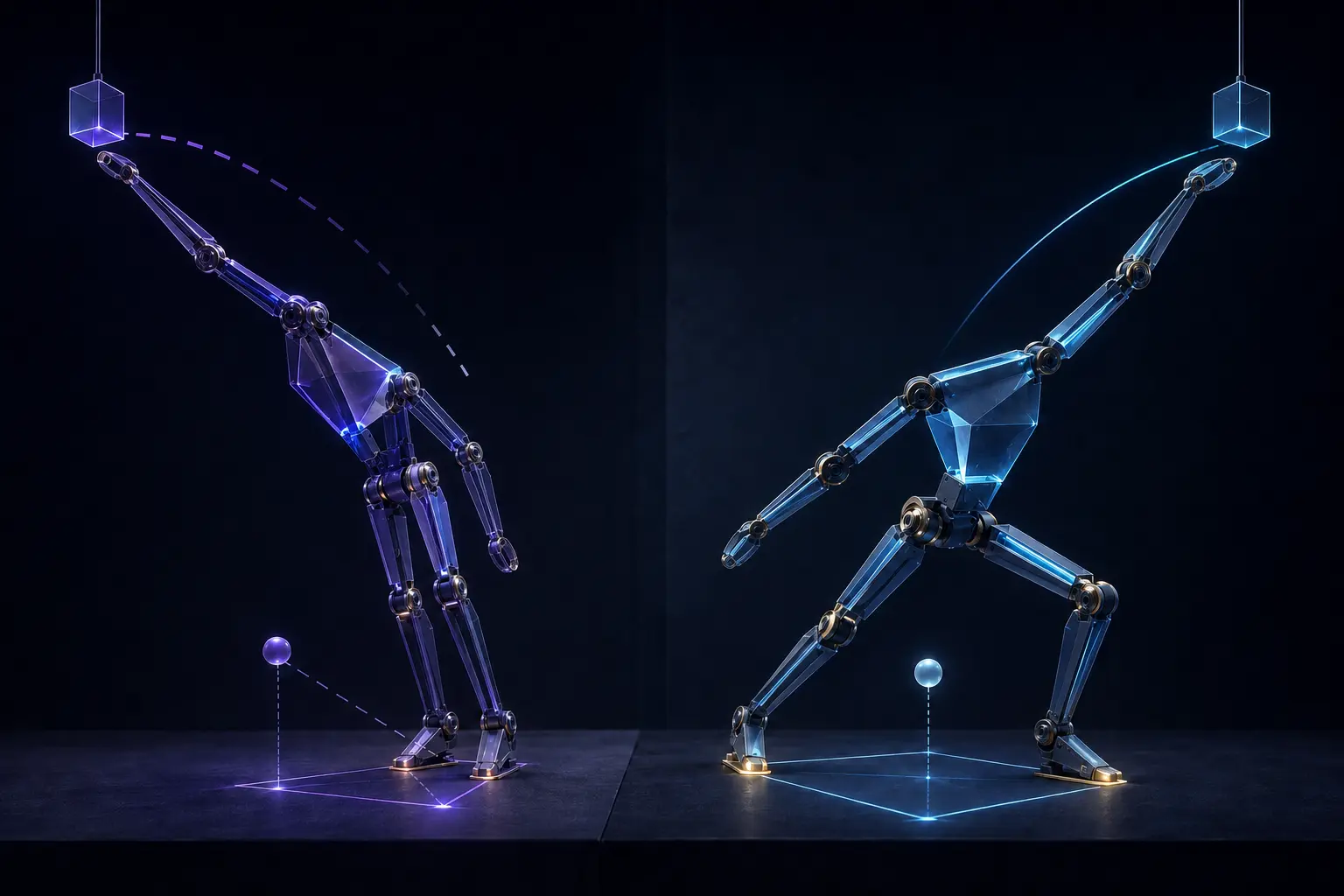
The original animated SVG below shows a restrained whole-body task: standing balance, weight transfer, a step, a reach, object interaction and stabilisation. Ghosted articulated states make the coordination visible without depicting a branded or photorealistic humanoid.
- 01Standing balance
- 02Weight transfer
- 03Step
- 04Reach
- 05Object interaction
- 06Stabilisation
The centre-of-mass marker and support line change across the sequence. The motion is a conceptual study, not a simulation or demonstration of an Animatio.ai product.
Imitation and policy learning
Human motion is a reference, not a ready-made robot command.
Motion imitation uses examples to define desirable behaviour. A reference clip can supply style, phase and task structure more directly than a hand-written reward. DeepMimic demonstrated how reinforcement learning can combine an imitation objective with a task objective in physics simulation, producing policies that track reference skills while recovering from disturbance.
A human and humanoid do not share the same embodiment. Link lengths, joint axes, ranges, mass distribution, feet, hands and actuators differ. Human-to-robot motion retargeting therefore preserves selected relationships rather than copying every joint value. A pipeline may optimise the pose, filter infeasible motions in simulation and train a policy that can track the refined reference under robot dynamics.
Imitation learning trains from demonstrations. Reinforcement learning refines behaviour through reward and environment interaction. Hybrid methods can use imitation to establish a motion prior and task reward to adapt it. Curriculum, domain randomisation and privileged information in simulation can help training, but deployed policies still rely on observations available on the real machine.
Motion policies and general-purpose skill
A motion policy maps a state, command or observation to action. General-purpose skill requires more than placing many behaviours in one model. The system must transition between skills, respond to different environments, recover from error and avoid catastrophic interference. High-level task planning and low-level stabilisation may operate at different rates and levels of abstraction.
Physical feasibility
Reaching the target is not the same as surviving the motion.
Kinematic feasibility asks whether joint geometry can reach a pose without violating limits or collision constraints. Dynamic feasibility asks whether forces, momentum, contact and actuators can produce and sustain the movement. A pose can satisfy inverse kinematics while placing the centre of mass outside support or demanding unavailable torque.
| Question | Kinematic view | Dynamic view |
|---|---|---|
| Can the target be reached? | Joint geometry and limits | Geometry plus force, momentum and time |
| What defines support? | Contact location | Contact force, friction and centre-of-mass behaviour |
| What constrains speed? | Often added as joint limits | Actuator bandwidth, torque, inertia and stability |
| What makes a pose valid? | No geometric violation | A controllable state that can be entered and exited |
Hardware limits shape every policy. Actuators have finite torque, speed, precision, compliance and thermal capacity. Batteries and computation constrain duration and control rate. Sensors introduce noise and delay. A simulator or reference motion that ignores these limits may reward behaviour the machine cannot reproduce.
From simulation to the world
Training can scale in simulation; consequence arrives in reality.
Simulation allows humanoid policies to experience falls, disturbance and varied terrain without the full cost of physical trials. Massive parallel environments can generate many transitions for reinforcement learning. Sim-to-sim tests across physics engines can reveal overfitting to one implementation before hardware deployment.
Real execution remains a separate test. Contact, drivetrain dynamics, structural flex, latency and sensing differ. Domain randomisation and system identification reduce the gap. Staged validation, conservative limits, fall protection and the ability to stop safely remain operational requirements rather than machine-learning metrics.
Task choreography and readable movement
Task choreography organises locomotion, reach, contact and manipulation into a purposeful sequence. In human environments, movement also communicates. Approach speed, posture and pausing can make intent more legible to nearby people. Expressive motion is not theatrical excess; carefully used, it can support predictability and supervision.
Readability cannot override safety or task mechanics. A gesture must remain within balance and workspace constraints. A system should not imply confidence it does not have. Human-aware motion therefore joins engineering with interaction design and clear control authority.
Commercial territory
Humanoid motion may become a platform layer, not one feature.
The commercial stack can include simulation environments, retargeting, motion data, teleoperation, policy training, evaluation, whole-body controllers, safety systems, actuator interfaces and task orchestration. Different companies may own different parts. A strong product position should identify a concrete bottleneck and the robot classes it serves.
Research on digital humans and character motion can contribute representations, demonstrations and models of expressive timing. Robotics contributes physical feasibility, contact, feedback and control. The bridge is valuable precisely because the output requirements differ: a motion can be visually persuasive yet mechanically unusable.
Humanoid form attracts broad narratives, but realistic positioning remains essential. Capabilities vary by task, hardware and environment. General-purpose operation requires reliable skill composition, perception, recovery and safety—not only a compelling demonstration.
Conclusion
Whole-body intelligence is coordination under consequence.
Humanoid movement becomes useful when posture, contact, locomotion and manipulation resolve into one physically feasible action. References and learned models can widen the skill set; whole-body planning, control and feedback keep that movement connected to the actual body.
Animatio.ai does not claim humanoid technology. This guide maps a serious application territory inside motion intelligence and connects it with the broader robot motion planning and control stack.
FAQ
Questions and direct answers
01Why is humanoid motion especially difficult?+
A humanoid is a high-dimensional, underactuated system that must coordinate many joints while maintaining balance through changing contacts. Locomotion and manipulation affect one another, and small modelling or timing errors can create large physical consequences.
02What is whole-body control?+
Whole-body control coordinates multiple joints, limbs and contacts around shared task and stability objectives. Instead of treating an arm reach, torso posture and foot support as separate problems, it resolves their interaction under kinematic, dynamic and actuator constraints.
03How is human motion retargeted to a humanoid robot?+
Retargeting maps a human reference onto a different mechanical embodiment. Useful pipelines adjust for link lengths and joint limits, preserve task-relevant relationships, filter infeasible poses, model contacts and train a controller that can track the refined motion under real dynamics.
04What is the difference between balance and locomotion?+
Balance manages the relationship among centre of mass, momentum and available contacts. Locomotion deliberately changes those contacts to move through space. Walking therefore requires repeated controlled loss and recovery of support, not merely a sequence of leg poses.
05Why does expressive movement matter for humanoids?+
Movement can communicate intent, confidence, yielding and task state to people sharing the environment. Expressiveness must remain subordinate to safety and feasibility, but readable timing and posture can make physical behaviour easier to anticipate and supervise.
Primary sources
Sources reviewed
- DeepMimic: Example-Guided Deep Reinforcement Learning of Physics-Based Character Skills
ACM SIGGRAPH / arXiv . Demonstrates learned physics-based imitation, recovery and goal-conditioned behaviour.
- Learning Human-to-Humanoid Real-Time Whole-Body Teleoperation
Carnegie Mellon University / arXiv . Presents a sim-to-data filtering and imitation pipeline for real-time whole-body humanoid motion.
- Humanoid-Gym: Reinforcement Learning for Humanoid Robot with Zero-Shot Sim2Real Transfer
arXiv . Documents simulation training, domain randomisation and cross-simulator validation for humanoid locomotion.
- Humanoid Locomotion and Manipulation: Current Progress and Challenges in Control, Planning, and Learning
arXiv . A research survey spanning model-based and learning-based approaches to locomotion and manipulation.
- Whole-Body Model-Predictive Control of Legged Robots with MuJoCo
arXiv . Studies whole-body predictive control for quadruped and humanoid systems using contact dynamics.
Sources are listed for terminology and technical context. Their inclusion does not imply affiliation with Animatio.ai. Explanations on this site are original paraphrases, not reproduced research figures or source text.