Research-led explainer · generative digital motion
AI motion generation: from prompts to movement.
AI motion generation is the use of computational models to create movement over time from inputs such as text, images, audio, video, action labels, motion examples or environmental constraints.
Conceptual research resource · Not an operating product or research institution

Definition
Generation starts with intent and ends with a sequence.
AI motion generation turns conditions into movement. A condition can be a phrase such as “walk cautiously,” a key pose, a path through a scene, an audio performance, a video demonstration or a set of environmental constraints. The result may be joint rotations, Cartesian trajectories, a discrete sequence of motion tokens, an editable animation rig or rendered video.
The term therefore spans related but distinct tasks. Text-to-motion usually connects language with an explicit articulated representation. Text-to-videogenerates pixels across time. Human motion synthesisfocuses on pose sequences that depict people. Character and avatar systems may combine generated movement with interaction rules, expression, speech and identity continuity.
A prompt rarely determines one correct answer. “A person approaches a chair” could admit different speeds, paths, gaits and gestures. A useful model should capture plausible variation while allowing a user or downstream system to control the aspects that matter: timing, trajectory, body-part involvement, contact, style and environment.
- 01Text / image / demonstrationIntent or reference
- 02Motion representationPoses, joints, tokens or trajectories
- 03Generative modelProduces one or more candidate sequences
- 04Temporal refinementContinuity, contact and constraints
- 05Character or avatar motionEditable or rendered output
The pipeline is illustrative. Real systems can condition the generator at several stages and may combine learned models with optimisation or authored constraints.
Representation
A model can only generate what its motion language can express.
A pose describes an articulated state at one time. A sequence of poses describes movement, but the coordinate system and features matter. Joint rotations preserve skeletal articulation. Global joint positions make spatial relationships explicit. Root motion describes how the body travels. Contact flags can indicate when feet or hands should remain attached to a surface. Velocities and accelerations reveal change rather than position alone.
Continuous representations are natural for precise geometry and smooth interpolation. Discrete representations compress movement into tokens or codes that can work well with sequence models and language conditioning. Neither is universally superior. Compression can simplify learning while removing subtle timing; dense joint features preserve detail while increasing dimensionality and sensitivity to skeleton conventions.
Diffusion and other generative models
Motion diffusion models learn to reverse a process that corrupts motion data with noise. At generation time, they iteratively denoise toward a movement conditioned on text or other signals. The probabilistic process supports multiple plausible results from the same instruction. Autoregressive models, variational approaches, flow-based methods and hybrid systems offer different trade-offs in speed, diversity, long-range structure and control.
Model architecture does not solve the full task by itself. Training data defines which bodies, actions, cultures, environments and interaction patterns are represented. The model must also align language with time: which phrase controls which body part, when one action ends and another begins, and how a scene changes the motion.
Genuine motion study
Intent becomes coherent movement through time.
The sequence below is an original animated SVG motion graphic. It represents input signals becoming an explicit motion structure, multiple related poses and a grounded final action. The mobile version is separately composed vertically so the full progression remains readable. Playback pauses offscreen and when the document is hidden.
- 01Intent
- 02Motion representation
- 03Temporal sequence
- 04Pose evolution
- 05Coherent movement
The visual demonstrates continuity and changing joint relationships. It is a conceptual motion study, not the output of an operating Animatio.ai model.
Control and adaptation
Style transfer and retargeting change different things.
Motion style transfer changes qualities such as rhythm, energy, posture or expressiveness while attempting to preserve the underlying action. A “tired walk” and a “confident walk” may follow the same route but differ in cadence, arm swing and torso organisation. Content and style are not perfectly separable because changing timing can also change contact and feasibility.
Motion retargeting transfers a movement to another skeleton or embodiment. Different link lengths and joint structures mean that copying rotations can place feet or hands incorrectly. A stronger retarget preserves task relationships—contact, direction, reach and timing—while solving for the target body’s limits.
Character animation tools may combine generation with authored keyframes, inverse kinematics, trajectory constraints and artist correction. Avatars and digital humans add responsiveness: generated gesture must align with speech, identity, interaction state and the other participants in a scene. The goal is not to remove direction, but to make motion easier to create, vary and control.
Text-based motion editing extends the same idea. An instruction might modify one body part, speed up a phase or add an action while preserving the rest. Local edits remain difficult because the body is coupled: moving an arm can affect balance, timing and contact.
Failure modes
Plausible poses can still make an implausible movement.
Generated sequences commonly reveal errors only when viewed over time. Foot sliding occurs when a planted foot drifts while the body moves. Jitter introduces high-frequency changes that have no purposeful cause. Broken contactseparates a hand from an object it should hold. Temporal discontinuity jumps between incompatible states. In video, identity or geometry can drift even when individual frames look convincing.
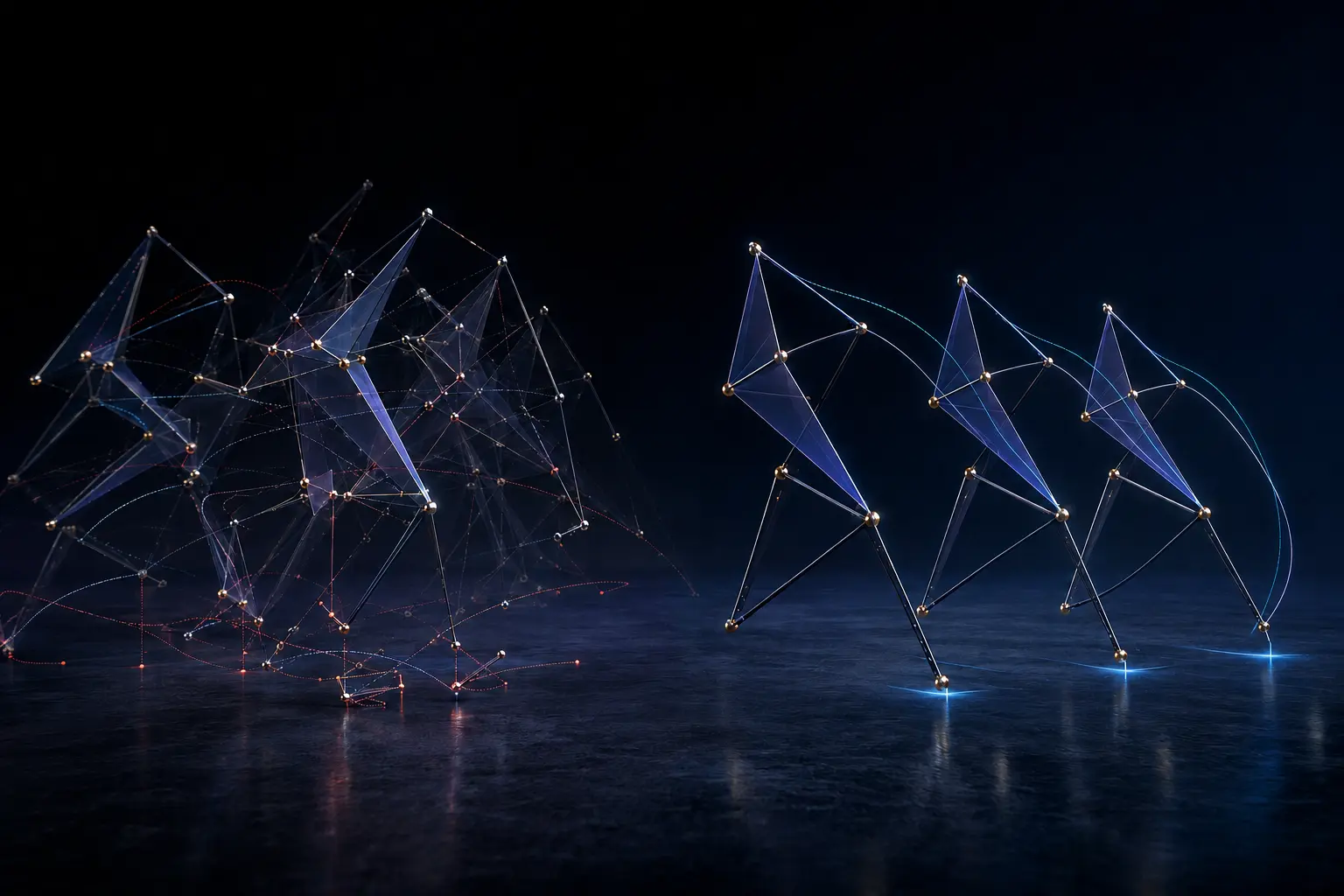
Constraints can be learned, optimised or enforced after generation. Contact-aware losses, keyframes, body-part controls, scene geometry and physics guidance can improve results. Each also reduces some freedom. Controllability is therefore a design decision about which variation is useful and which relationships must remain fixed.
| Criterion | Digital character motion | Physical robot motion |
|---|---|---|
| Primary test | Visual, semantic and interactive coherence | Task success under real dynamics and safety constraints |
| Contact | Can be stylised or corrected in rendering | Creates forces and changes stability |
| Body limits | Defined by the chosen rig and artistic rules | Fixed by mechanism, actuators, sensing and materials |
| Error cost | Regeneration or editorial correction | Hardware, object or human risk |
| Transfer | Retarget to another rig | Retarget, test feasibility, learn control and validate |
Applications
Creative motion spans production, characters and interaction.
Animation and virtual production can use generated motion for early blocking, variations, background action and performance exploration. Games can create responsive characters whose movement follows player state and environment rather than a fixed clip library. Product visualisation can generate controlled camera, object and assembly motion. Interactive agents can coordinate gesture and posture with dialogue.
These applications require different guarantees. A cinematic shot can tolerate offline refinement. A live avatar has strict latency and identity continuity. A game character must respect navigation and collision. A reusable animation asset needs an explicit representation, while a final video may prioritise pixels.
The relationship to robotics
Digital motion research and robotics meet around representations, demonstrations and temporal models. Human motion can suggest intent, task structure or a reference behaviour. Physics-based character control shows how a learned policy can imitate a reference while responding to disturbance. Robot execution, however, adds embodiment- specific dynamics, planning, control, sensing and safety.
A generated sequence should therefore be described honestly. It may be visually coherent, kinematically valid or dynamically feasible—and those are different claims. The robot motion intelligence guide follows the pipeline from perception and planning through actuation and feedback.
Conclusion
The useful frontier is controllable sequence, not isolated spectacle.
AI motion generation becomes valuable when it gives creators and systems a movement they can understand, direct and reuse. That requires explicit choices about representation, temporal coherence, contact, style, identity and the relationship between a generated possibility and its target environment.
Animatio.ai does not claim to provide this technology. The page maps a credible application territory for the identity and connects it to the wider concept of motion intelligence.
FAQ
Questions and direct answers
01What inputs can an AI motion-generation system use?+
Inputs may include natural-language instructions, action labels, images, audio, video, motion-capture demonstrations, key poses, trajectories, scene geometry or combinations of these signals. The useful representation depends on the target character, environment and degree of control required.
02What is the difference between text-to-motion and text-to-video?+
Text-to-motion usually produces an explicit motion representation such as joint poses or trajectories that can drive a character. Text-to-video produces pixels over time. Video can look convincing while remaining difficult to edit or execute, whereas explicit motion can be retargeted, constrained and inspected more directly.
03Why do generated characters sometimes slide or jitter?+
Foot sliding, jitter and broken contact often arise when frame-level plausibility is not matched by strong temporal, kinematic or environmental constraints. A model may generate locally plausible poses without preserving consistent velocity, contact timing or support across the full sequence.
04Can generated human motion be applied directly to a robot?+
Usually not. A robot has different proportions, joints, torque limits, balance requirements and contact dynamics. Human motion can provide intent or a reference, but retargeting, feasibility filtering, policy learning and control are generally needed before physical execution.
05How should AI-generated motion be evaluated?+
Evaluation should consider more than visual realism. Relevant dimensions include semantic alignment with the input, diversity, temporal coherence, contact quality, controllability, identity consistency, physical plausibility and whether the result succeeds in its intended downstream task.
Primary sources
Sources reviewed
- Generating Diverse and Natural 3D Human Motions from Texts
CVPR 2022 project page . Introduces HumanML3D and aligns free-form language with 3D human motion.
- MotionDiffuse: Text-Driven Human Motion Generation with Diffusion Model
arXiv / IEEE TPAMI . Presents probabilistic diffusion-based motion synthesis and multi-level manipulation.
- Motion-X: A Large-scale 3D Expressive Whole-body Human Motion Dataset
arXiv / IDEA Research . Extends motion data toward expressive whole-body movement including hands and facial components.
- MotionFix: Text-Driven 3D Human Motion Editing
arXiv . Studies instruction-based editing of body parts, timing, speed and motion style.
- DeepMimic: Example-Guided Deep Reinforcement Learning of Physics-Based Character Skills
ACM SIGGRAPH / arXiv . Shows why visually specified motion and physically controlled motion are related but not identical.
Sources are listed for terminology and technical context. Their inclusion does not imply affiliation with Animatio.ai. Explanations on this site are original paraphrases, not reproduced research figures or source text.